METAL DETECTING STRATEGY
Field Finders-Read the Land Before You Dig: The Ultimate Research Toolkit
Stop guessing where to swing your coil and turn the British countryside into a transparent roadmap of the past. FieldFinders is the UK’s most advanced research toolkit and permissions marketplace built specifically for serious detectorists. Instead of cold-calling farmers or walking blindly into empty fields, this powerful web app puts deep, uncompromised historical and geological data directly into your hands, allowing you to thoroughly scout any site before your boots ever hit the mud.
At the heart of the platform is an advanced data ecosystem designed for rigorous archaeological prospection:
- High-Resolution 1m LiDAR Terrain Mapping: Strip away trees, crops, thick vegetation, and modern topsoil at the tap of a button. The app's highly detailed 1m LiDAR hillshade layers reveal hidden contours, long-forgotten field systems, buried structures, and sunken pathways completely invisible to the naked eye or standard satellite views.
- AI-Powered "Trace" Feature: Let technology do the heavy lifting. The integrated AI engine actively scans the LiDAR terrain to automatically detect, highlight, and circle ancient earthworks and landscape anomalies that the human eye easily overlooks.
- 1.6 Million+ PAS Find Records: Research with historical context. FieldFinders is directly wired into the Portable Antiquities Scheme database, showing you local, officially recorded historical finds so you can identify high-potential hotspots based on real archaeological precedence.
- Historic OS Map Overlays: Seamlessly layer historic Ordnance Survey maps over modern satellite imagery to track how the boundaries, roads, and settlements changed over centuries.
FieldFinders doesn't just give you the data to find history—it provides the legal permission to uncover it. Browse land listings by soil type and historical era, book your detecting sessions instantly, and log your finds securely. Welcome to the future of metal detecting.
My Metal Detecting Strategy: A Step-by-Step Field Search Method
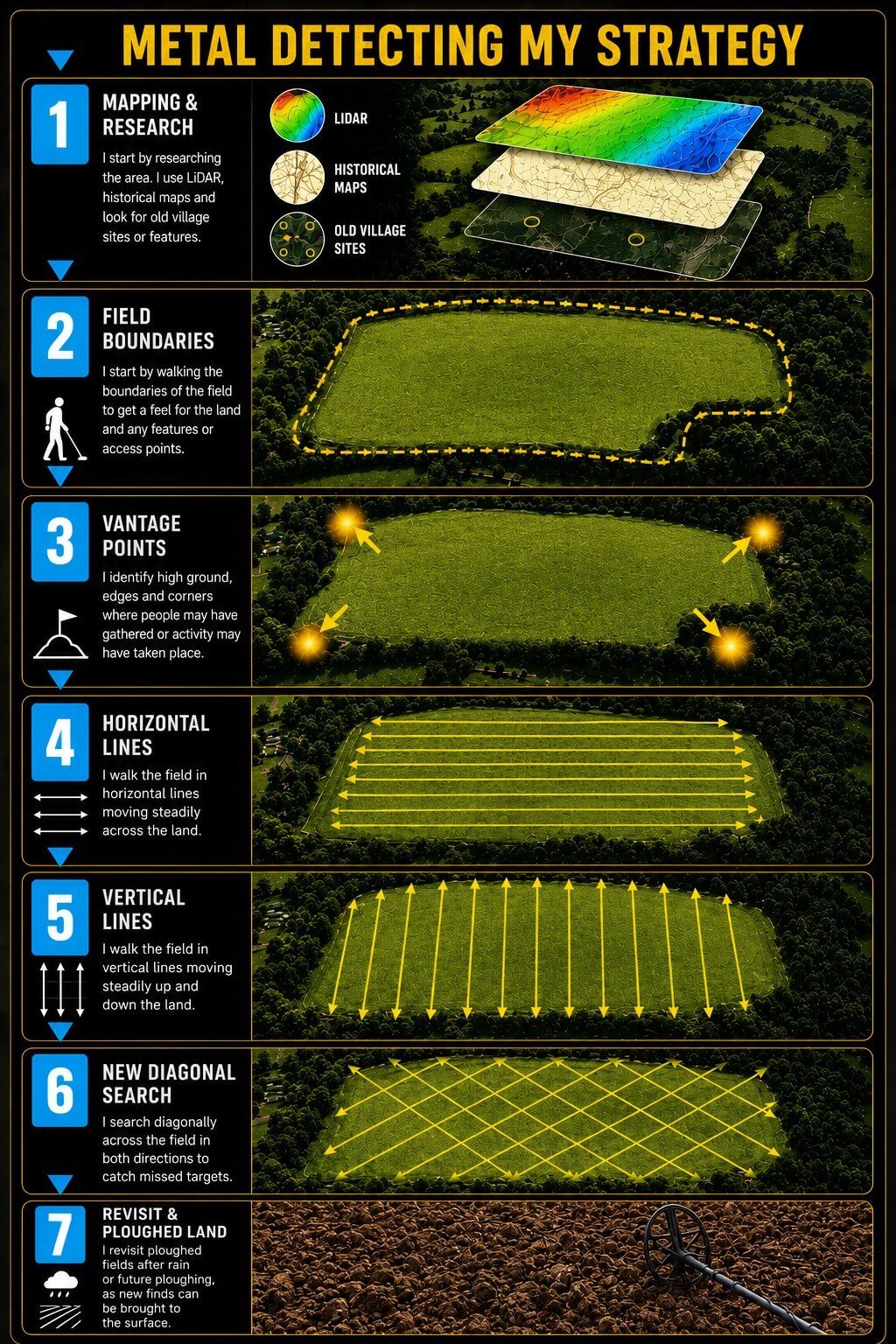
My metal detecting strategy combines historical research, LiDAR and map analysis, field boundary checks, vantage-point assessment, and systematic search patterns. I search fields using horizontal, vertical, and diagonal coverage before revisiting ploughed land after rain or fresh cultivation, when previously buried finds may be brought closer to the surface.
In the image below you will see how i execute the seven steps of searching a field.